


UPSIREN
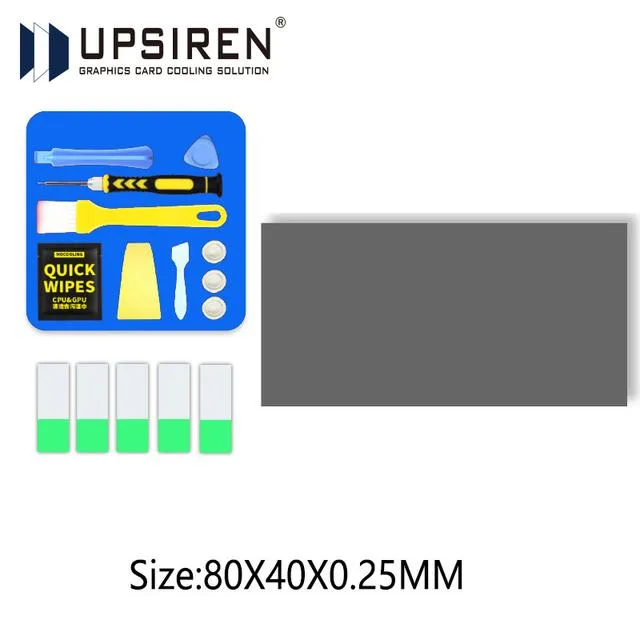
UPSIREN PCM-1 Thermal Paste Pad 80x40x0.25mm
Phase-change silicone pad turns liquid above 45 °C for even coverage, then solidifies to stop overflow, lasting 2-3 times longer than standard paste
Option 80x40x0.25mm
- 80x40x0.25mm
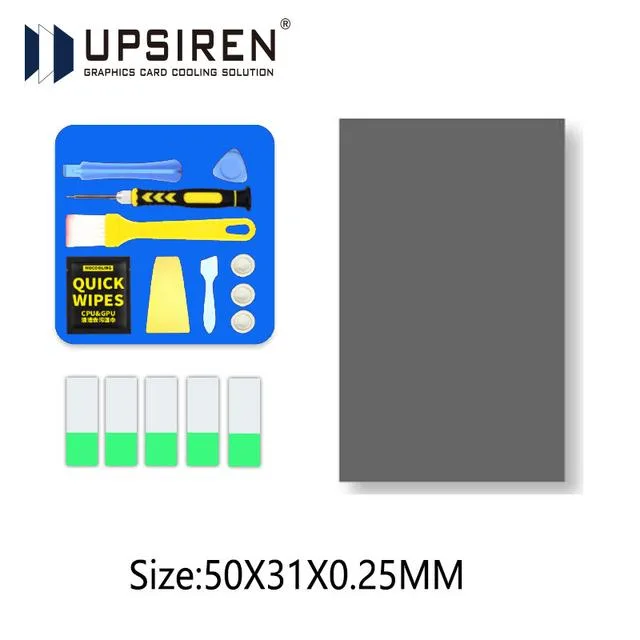
- 50×31×0.25mm
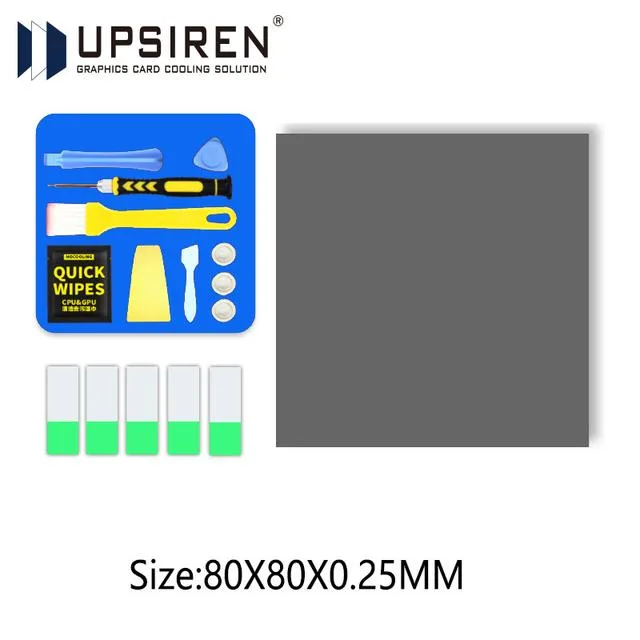
- 80x80x0.25mm
- Phase-change silicone grease stays solid below 45 °C, preventing overflow around CPU or GPU
- Service life rated 2-3 times longer than ordinary thermal grease
- Cut pad to chip size, peel both films, no front or back orientation needed
- Thermal impedance below .04 °C·cm²/W at .25 mm thickness for efficient heat transfer
- Passes 150 °C bake for 1000 hours and 1000 thermal cycles for proven reliability
Phase-change silicone pad for CPUs and GPUs
UPSIREN PCM-1 is a 0.25 mm thick phase-change thermal interface sheet sized at 80 by 40 mm. It replaces traditional grease with a solid pad that softens above 45 degrees Celsius to fill microscopic gaps. The material stays in place once it re-solidifies below that temperature, preventing pump-out around the die edges. It is aimed at enthusiasts repasting processors or graphics cards who want a cleaner, long-lasting application.
Upgrade from liquid paste that pumps out over time
Conventional silicone grease tends to migrate away from the heat source after repeated thermal cycles, leaving uneven coverage and dried-out centres. This pad eliminates that creep because it returns to a solid state when the component cools below 45 degrees. The manufacturer rates the service life at two to three times that of ordinary grease, making the switch worthwhile for builds that run hot continuously or sit in hard-to-reach loops. Installation is a simple cut-to-size and peel process with no curing wait.
Thin 0.25 mm layer suited to flat, mating surfaces
The pad delivers a tested thermal impedance below 0.04 C cm squared per watt after reliability validation at 150 degrees for 1000 hours and 1000 thermal cycles. It performs best between flat copper or nickel-plated cold plates and bare die or integrated heat spreaders with minimal warpage. Because the material only exists in this single thickness, it cannot bridge large gaps or compensate for bowed coolers; users with uneven mounting pressure or stepped packages should look for a thicker compressible pad instead.
Highlights
- Phase-change silicone grease stays solid below 45 °C, preventing overflow around CPU or GPU
- Service life rated 2-3 times longer than ordinary thermal grease
- Cut pad to chip size, peel both films, no front or back orientation needed
- Thermal impedance below .04 °C·cm²/W at .25 mm thickness for efficient heat transfer
- Passes 150 °C bake for 1000 hours and 1000 thermal cycles for proven reliability
Specifications
No published specifications for this item yet.
Other versions of this model
2 more in the same range
Same family, different memory, cooler or clock — compare before you commit.

Questions about this item
Will the 80x40x0.25mm pad fit my CPU or GPU die?
The pad measures 80 by 40 millimetres and is 0.25 millimetres thick; cut it to match the exact die size and verify your cooler’s mounting pressure can accommodate that thickness.
How do I install the phase-change pad and what step is often missed?
Remove both protective films — there is no front or back — place the pad on the die, mount the cooler, then run the system above 45 °C for at least two hours so the material liquefies and wets the interface.
How long before the PCM-1 pad needs replacement?
The supplier rates service life at two to three times that of ordinary grease, backed by 150 °C bake and 1000 thermal-cycle reliability testing.
New to this? Which coin should you pay with — what to check, what it costs to pay, and what is never asked for.
Also in this aisle
People compared these
Same shelf, same checkout — eight coins and a 30-minute rate lock.

Innovation First, Inc.
Innovation First, Inc. 1UCMA-137 1U Cable Management Arm 19" 28.5"-33" computer accessory
- Product Type:Cable…
- Panel Width:19" Rac…
$72.99
0.00086744BTC
In stock
Vertiv
Vertiv 4UTELECOMRKIT 19 in rack mount bracket accessory
- GXT4U Wall Mount Br…
- Mounting Bracket
$70.99
0.00084367BTC
In stock
