

Innovation First, Inc.
Innovation First, Inc. 1UCMA-137 1U Cable Management Arm 19" 28.5"-33" computer accessory
- Product Type:Cable…
- Panel Width:19" Rac…
$72.99
0.00086782BTC
In stockWe take cryptocurrency — so the coins you hold can buy real hardware.Pay in crypto, spend it on real hardware. Free insured shipping worldwide over $399. Plain, unbranded boxes, sent from Germany.Free insured shipping over $399. Your rate is locked for 30 minutes once checkout opens.Rate locked 30 minutes. Every item sealed, serial-checked and covered by a 24-month warranty.Sealed, 24-month warranty.


Rexus
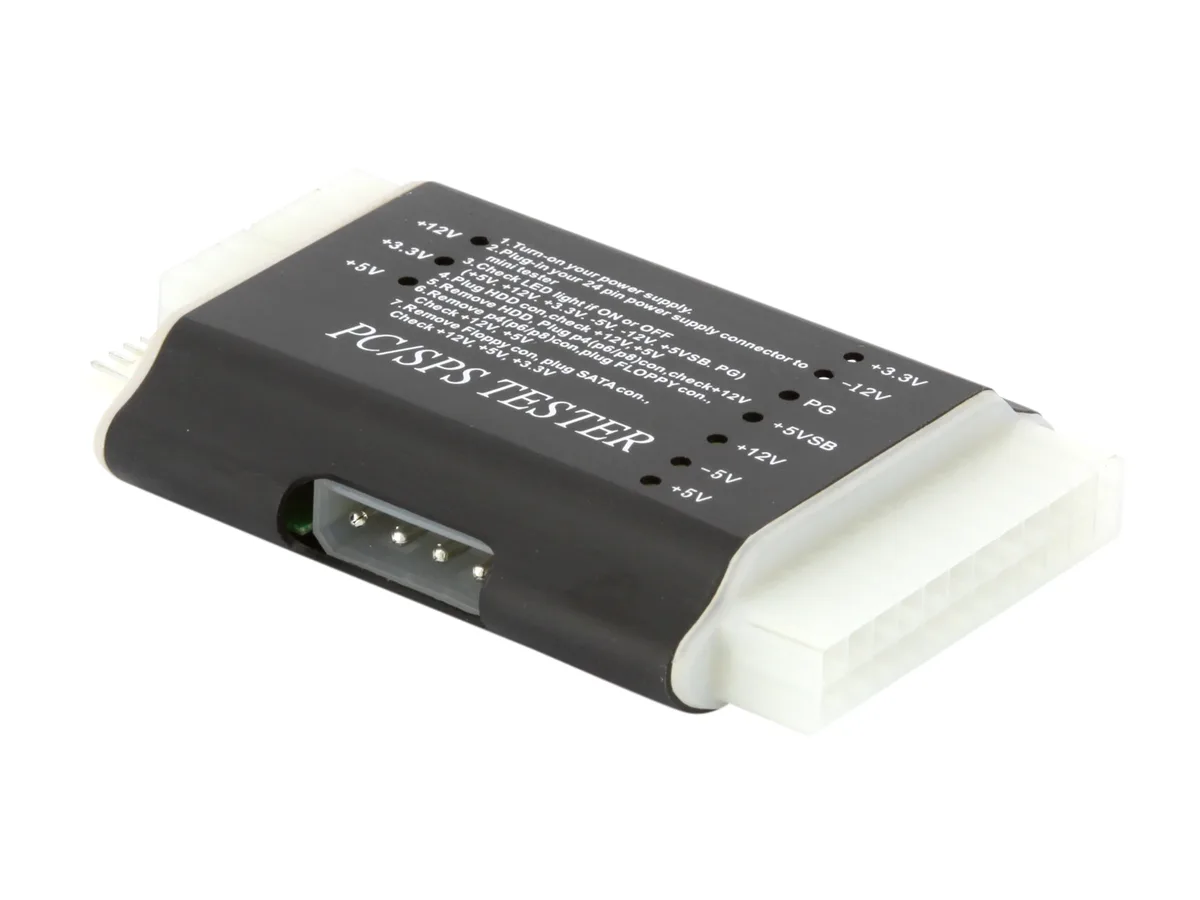
Tests 20-pin and 24-pin ATX, SATA, PCI-Express, Xeon, Pentium 4 and floppy connectors while verifying +3.3V, +5V, +12V, -12V, +5VSB and PG signals
The Rexus PST-2 is a compact diagnostic tool for checking desktop power supplies. It connects directly to 20-pin and 24-pin ATX headers plus auxiliary connectors to verify rail voltages. Technicians and system builders use it to confirm a unit is functional before installation.
The single specification that determines suitability is the range of connectors supported. This tester covers 20-pin and 24-pin ATX, SATA, Pentium 4, PCI-Express, Xeon, floppy and standard 4-pin power plugs. It reads +3.3V, +5V, +12V, -12V, +5VSB and PG signals.
The device comfortably handles ATX supplies that still provide the -5V rail removed from the design guide after version 1.2 in 1993-1994. It does not apply a load, so it cannot reveal voltage drop under real-world current draw. Builders needing loaded stress tests require separate equipment.
| Brand | Rexus |
|---|---|
| Model | PST-2 |
| Specifications | Test for: Tests 20-pin and 24-pin power supplies Tests SATA power Tests Pentium 4 power connector Tests PCI-Express power connectors Tests Xeon power connectors Tests Floppy drive connectors Tests standard 4-pin power supply connectors Tests for +3.3V, -12V, PG, +5VSB, +12V, -5V, +5V outputs Note: The -5V DC output is took off from Intel ATX12V design guide since the 1.2 version. 1. The -5V usage was for last generation ISA slot. But the old ISA had been phased out since 1993~1994. 2. Neither P3 nor P4 systems will need -5V output. |
| Features | This product is a simple tester for switching power supply. It makes it easy to test the power supply output. 1. Turn-on your power supply. 2. Plug-in your 24 pin power supply connector to mini tester 3. Check LED light it ON or OFF (+5V. +12V. +3.3V. -5V. -12V. +5VBS. PG) - If the power output is working, the LED will light and you will hear a sound - If the power output fails, you won't see the LED light & no sound 4. Plug the HDD con, check +12V, +5V 5. Remove HDD, Plug p4(p6/p8)con, check +12V 6. Remove p4(p6/p8)con, plug FLOPPY con, check +12V, +5V 7. Remove Floppy con, plug SAT |
| Shipping weight | 0.09 kg |
| Package size | 114 × 79 × 25 mm |
The unit lights LEDs for +12V, +3.3V, +5V, +5VSB, -12V and PG so you can see at a glance whether each rail is present.
It has sockets for 20-pin and 24-pin ATX, 4-pin and 8-pin CPU, 6-pin and 8-pin PCI-Express, SATA, floppy and standard 4-pin peripheral plugs.
The tester body is a compact handheld module that plugs directly onto the 24-pin header; only the depth of the connector itself is required.
New to this? Which coin should you pay with — what to check, what it costs to pay, and what is never asked for.
Also in this aisle
Same shelf, same checkout — eight coins and a 30-minute rate lock.
What you pay in, and what you read prices in.
Sent from your wallet at checkout
Display only — the catalogue is priced in USD
No currency matches that.
Pick the language the site speaks to you in.
No language matches that.
New here?
Already have one?
There is no automatic reset: this shop sends no mail, so there is no one-time link to ask for. Leave the address on the account and it gets picked up by hand.
Request noted
Nothing is on its way to your inbox — this shop sends no mail at all. Someone picks these up by hand.
Remembered it?


