


Raspberry Pi
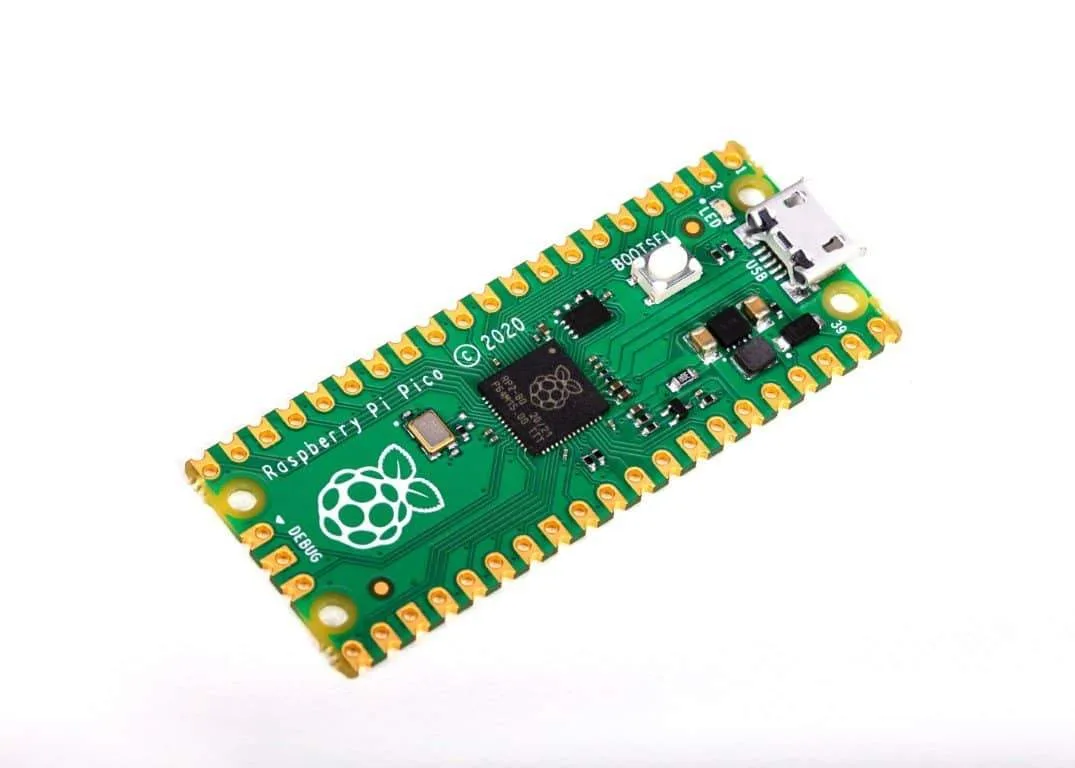
Raspberry Pi Pico RP2040 Microcontroller Board
A dual-core microcontroller board with 26 GPIO pins, 264 KB SRAM, 2 MB Flash and USB 1.1 for drag-and-drop programming
- Dual-core Arm Cortex M0+ processor runs up to 133 MHz for responsive real-time control
- 264 KB SRAM and 2 MB Flash give ample space for firmware and data buffers
- 26 multi-function GPIO pins plus 16 PWM channels support diverse sensors and actuators
- USB 1.1 host and device with drag-and-drop programming simplifies development workflow
- Castellated edges allow direct soldering to carrier boards for compact embedded integration
RP2040 Microcontroller Board
The Raspberry Pi Pico is a low-cost microcontroller board built around the RP2040 chip designed in the United Kingdom. It features a dual-core Arm Cortex M0+ processor with a flexible clock running up to 133 MHz. The board provides 264 KB of SRAM and 2 MB of on-board Flash memory for program storage. Its castellated module design allows direct soldering to carrier boards for embedded integration.
Hobbyists and embedded engineers
This board suits developers who need a compact, programmable platform with flexible digital interfaces for custom hardware projects. The 26 multi-function GPIO pins support 2 × SPI, 2 × I2C, 2 × UART, 3 × 12-bit ADC, and 16 controllable PWM channels. Buyers who require built-in wireless connectivity, higher processing throughput, or an operating system environment should look at alternative platforms. The USB 1.1 interface provides device and host support along with drag-and-drop programming via mass storage.
RP2040 dual-core processor
The defining specification is the RP2040 microcontroller with its dual-core Arm Cortex M0+ architecture running up to 133 MHz. This processor includes 8 Programmable I/O state machines for custom peripheral support and accelerated floating-point libraries on-chip. An accurate clock, timer, and temperature sensor are integrated alongside low-power sleep and dormant modes. Verify that the 264 KB SRAM and 2 MB Flash capacity align with your firmware requirements before purchase.
Highlights
- Dual-core Arm Cortex M0+ processor runs up to 133 MHz for responsive real-time control
- 264 KB SRAM and 2 MB Flash give ample space for firmware and data buffers
- 26 multi-function GPIO pins plus 16 PWM channels support diverse sensors and actuators
- USB 1.1 host and device with drag-and-drop programming simplifies development workflow
- Castellated edges allow direct soldering to carrier boards for compact embedded integration
Specifications
No published specifications for this item yet.
Questions about this item
What spacing do the castellated pads use so I can match them to a carrier board?
The castellated module pads follow a standard pitch so the board can be soldered directly onto a carrier board or used with headers.
How do I load code onto the RP2040, and what is the step beginners often miss?
Hold the BOOTSEL button while plugging the USB 1.1 cable in; the board appears as a mass-storage device, then drag the UF2 file onto it — forgetting to hold BOOTSEL is the common mistake.
What will need replacing on the Pico after extended use?
The on-board 2 MB Flash memory handles all firmware storage, so no separate memory module requires replacement; only the board itself would be swapped if it fails.
New to this? Which coin should you pay with — what to check, what it costs to pay, and what is never asked for.
Also in this aisle
People compared these
Same shelf, same checkout — eight coins and a 30-minute rate lock.


Transway's Marketplace
Transway's Marketplace CU0122 1.8 m USB 3.0 A Male to B Male printer cable
$15.99
0.00018464BTC
In stock
Transway's Marketplace
Transway's Marketplace CU0093 1.8 m USB 2.0 A Male to B Male Printer Cable, Crystal Blue
$8.99
0.00010381BTC
In stock
Transway's Marketplace
Transway's Marketplace 10 ft USB to Parallel Printer Adapter
$21.99
0.00025392BTC
In stock