

Knox Gear, Inc.
Knox Gear KN-GC02 39" Hard Shell Guitar Case Gold Hardware
- Guitar Bag
$62.99
0.0007302BTC
In stockWe take cryptocurrency — so the coins you hold can buy real hardware.Pay in crypto, spend it on real hardware. Free insured shipping worldwide over $399. Plain, unbranded boxes, sent from Germany.Free insured shipping over $399. Your rate is locked for 30 minutes once checkout opens.Rate locked 30 minutes. Every item sealed, serial-checked and covered by a 24-month warranty.Sealed, 24-month warranty.


Vszerda
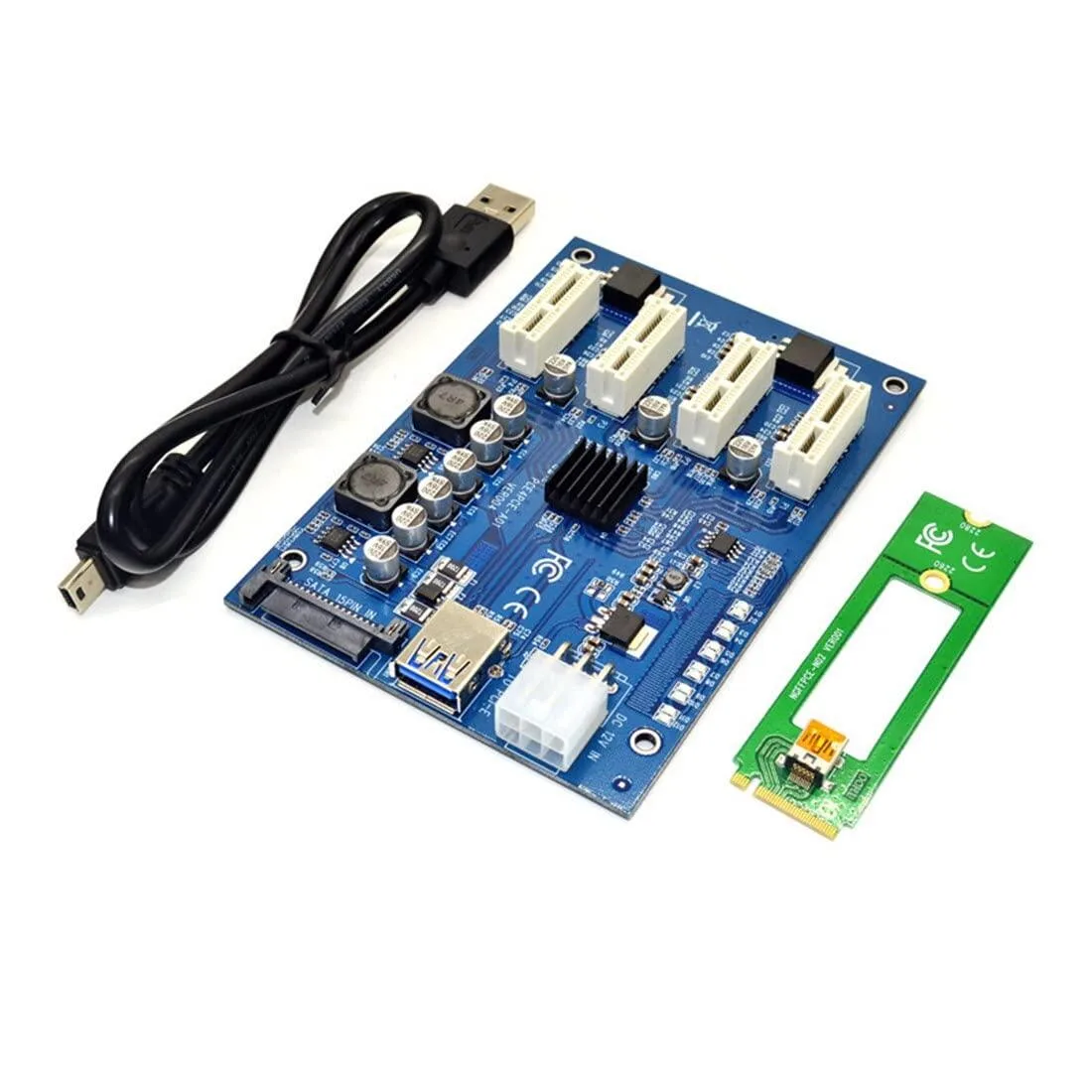
Adds four PCI-E 1× slots via an M.2 M-key or PCI-E 1× link connected by USB 3.0 cable, delivering about 150 MB/s per slot for low-bandwidth devices
This adapter splits a single M.2 M Key or PCIe x1 slot into four PCIe x1 connections using a two-board design linked by a USB 3.0 cable. It targets miners or hobbyists who need extra low-bandwidth slots for additional cards. The kit includes the main card, the device card and the interconnect cable. Compatible with Windows, Linux and macOS systems.
The main card plugs into an M.2 M Key or PCIe x1 slot while the device card provides the four x1 slots; a USB 3.0 cable bridges the two boards. Builders must supply auxiliary power via the onboard 6-pin SATA connector. The USB 3.0 link caps theoretical throughput at 625 MB/s and real-world bandwidth drops to roughly 150 MB/s shared across all four ports. Bandwidth contention is the typical bottleneck.
Each PCIe 1.x lane delivers up to 250 MB/s, but the USB 3.0 bridge restricts aggregate throughput to about 150 MB/s across the four slots. This makes the card unsuitable for high-performance GPUs, fast storage or any workload needing sustained throughput. It works only for low-bandwidth devices such as additional mining risers or basic I/O cards. The host slot should be PCIe 2.0 or 3.0 for best stability.
No published specifications for this item yet.
Check Device Manager for four PCI-E x1 links; each should show a 250 MB/s single-channel bandwidth at PCI-E 2.0 or 3.0.
The package includes the PCIe 1X multi-port riser card and one connection line; you must supply your own Sata power cables for the device card.
Use the M.2 M Key port if your motherboard has a free M.2 M Key slot; otherwise install the main card into a PCI-E x1 slot — both deliver the same four x1 ports via USB 3.0 at 625 MB/s theoretical bandwidth.
Also in this aisle
Same shelf, same checkout — eight coins and a 30-minute rate lock.
What you pay in, and what you read prices in.
Sent from your wallet at checkout
Display only — the catalogue is priced in USD
No currency matches that.
Pick the language the site speaks to you in.
No language matches that.
New here?
Already have one?
There is no automatic reset: this shop sends no mail, so there is no one-time link to ask for. Leave the address on the account and it gets picked up by hand.
Request noted
Nothing is on its way to your inbox — this shop sends no mail at all. Someone picks these up by hand.
Remembered it?


