

Seeed Studio
Seeed Studio XIAO nRF52840 Sense microcontroller board
- Sensors
$22.99
0.00026714BTC
In stockWe take cryptocurrency — so the coins you hold can buy real hardware.Pay in crypto, spend it on real hardware. Free insured shipping worldwide over $399. Plain, unbranded boxes, sent from Germany.Free insured shipping over $399. Your rate is locked for 30 minutes once checkout opens.Rate locked 30 minutes. Every item sealed, serial-checked and covered by a 24-month warranty.Sealed, 24-month warranty.


Seeed Studio
Measures UV, visible and infrared light from 280 to 950 nm over I2C, running on 3.0 to 5.5 V at 3.5 mA
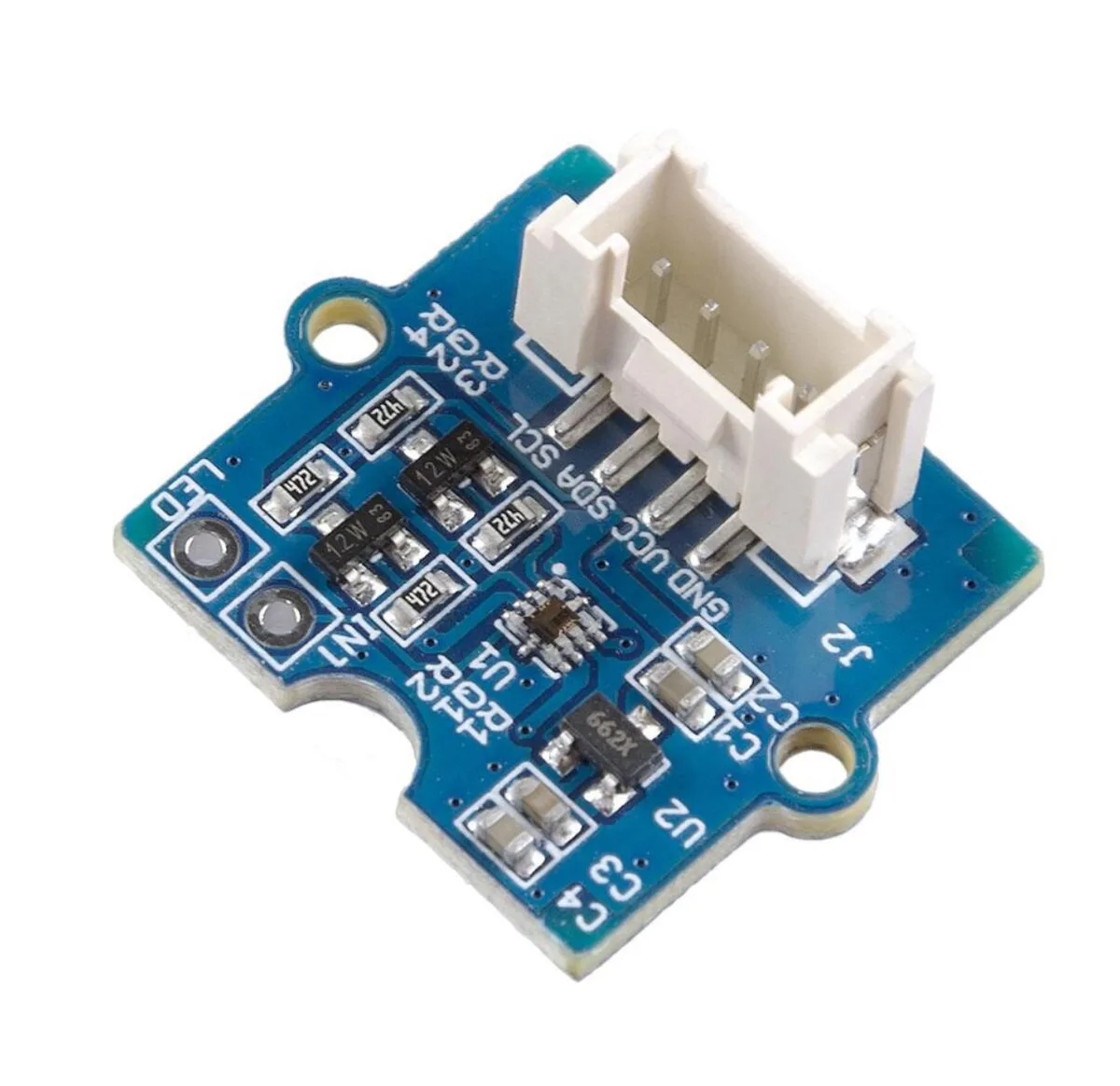
The Grove Sunlight Sensor SI1151 detects UV, visible and infrared light across a 280-950nm range using an I2C digital interface. It operates from 3.0 to 5.5V at 3.5mA, making it suitable for low-power microcontroller and single-board computer projects. The board measures 140mm by 85mm by 11mm and weighs 9g. It ships with a Grove cable for plug-and-play connection.
This module replaces separate UV-index, ambient-light or IR-proximity sensors by combining all three measurements in one package. The jump is worth it when a project needs simultaneous spectral data — for example a weather station that logs UV risk alongside visible brightness — without wiring multiple breakout boards. It is not for designs that require calibrated radiometric power readings or spectral resolution beyond the broadband channels provided.
The sensor connects directly to any Grove-compatible port on an Arduino, Raspberry Pi HAT or compatible SBC, requiring no soldering or level-shifting. Its 3.3/5V supply range frees the builder from adding a dedicated regulator. The interrupt output can wake a sleeping MCU on light-threshold events, saving battery in remote loggers. Builders needing analog output or a non-I2C protocol must add external circuitry.
| Type | Sensors |
|---|
The board measures 140 mm by 85 mm and is 11 mm thick, so allow at least that footprint plus room for the Grove cable to exit.
Plug the included Grove cable into the onboard Grove connector and the matching port on your shield; the step often missed is ensuring the host runs at 3.0–5.5 V so the 3.5 mA supply current is met.
The SI1151 has no user-replaceable parts; it operates from -45 °C to 85 °C across the 280–950 nm range and is designed for continuous use without scheduled replacement.
Also in this aisle
Same shelf, same checkout — eight coins and a 30-minute rate lock.
What you pay in, and what you read prices in.
Sent from your wallet at checkout
Display only — the catalogue is priced in USD
No currency matches that.
Pick the language the site speaks to you in.
No language matches that.
New here?
Already have one?
There is no automatic reset: this shop sends no mail, so there is no one-time link to ask for. Leave the address on the account and it gets picked up by hand.
Request noted
Nothing is on its way to your inbox — this shop sends no mail at all. Someone picks these up by hand.
Remembered it?


