Sunfounder
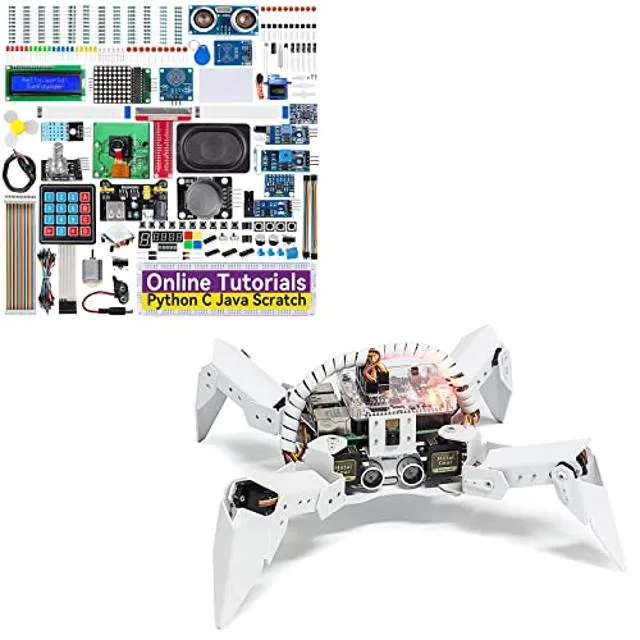
Sunfounder Raspberry Pi Ultimate Kit with PiCrawler AI Robot 337 components 131 projects
$174.99
0.00203512BTC
In stockWe take cryptocurrency — so the coins you hold can buy real hardware.Pay in crypto, spend it on real hardware. Free insured shipping worldwide over $399. Plain, unbranded boxes, sent from Germany.Free insured shipping over $399. Your rate is locked for 30 minutes once checkout opens.Rate locked 30 minutes. Every item sealed, serial-checked and covered by a 24-month warranty.Sealed, 24-month warranty.


NuoTo
Adds 24-bit 192 kHz audio with 112 dB SNR and hardware volume control to Raspberry Pi 3, 2B, B+, Zero W and A+ via HAT
The NuoTo X920 DAC+ HAT adds high-resolution analogue output to Raspberry Pi 3 Model B, 2B and B+ boards. It mounts directly on the 40-pin header and draws power from the host, so no separate supply is needed. The board targets hobbyists and media-centre builders who want better sound than the Pi’s own PWM output.
The on-board 3.5 mm jack on a Raspberry Pi is limited to 11-bit PWM quality. This HAT replaces it with a TI PCM5122 DAC delivering 24-bit 192 kHz playback, 112 dB SNR and –93 dB THD. The jump is worth it when you stream lossless files or run a dedicated player such as Volumio, Moode or RuneAudio and need transparent conversion.
The board exposes RCA and 3.5 mm phone-jack outputs at 2.0 V RMS line level. An on-board Vishay TSOP34838 IR receiver on GPIO 17 allows remote control. GPIO pins 18, 19 and 21 carry the I2S data stream, while the remaining header stays accessible for other HATs or sensors. Hardware volume control and a TI LP5907 ultralow-noise regulator keep the analogue section clean.
| CPU Type | Other |
|---|
The board receives I2S data on GPIO21, bit clock on GPIO18 and left-right clock on GPIO19, with a ground reference.
You must add the correct device-tree overlay for the PCM5122 DAC in config.txt before the IR receiver on GPIO17 and hardware volume control will function.
The built-in Vishay TSOP34838 receiver on GPIO17 is the only IR sensor; if it fails the board loses remote-control capability.
New to this? Buying PC parts with Monero — what to check, what it costs to pay, and what is never asked for.
Also in this aisle
Same shelf, same checkout — eight coins and a 30-minute rate lock.
What you pay in, and what you read prices in.
Sent from your wallet at checkout
Display only — the catalogue is priced in USD
No currency matches that.
Pick the language the site speaks to you in.
No language matches that.
New here?
Already have one?
There is no automatic reset: this shop sends no mail, so there is no one-time link to ask for. Leave the address on the account and it gets picked up by hand.
Request noted
Nothing is on its way to your inbox — this shop sends no mail at all. Someone picks these up by hand.
Remembered it?