

Extreme Networks
Extreme Networks Silhouette Ceiling Mounting Bracket 14 or 18
$23.99
0.00027772BTC
In stockWe take cryptocurrency — so the coins you hold can buy real hardware.Pay in crypto, spend it on real hardware. Free insured shipping worldwide over $399. Plain, unbranded boxes, sent from Germany.Free insured shipping over $399. Your rate is locked for 30 minutes once checkout opens.Rate locked 30 minutes. Every item sealed, serial-checked and covered by a 24-month warranty.Sealed, 24-month warranty.
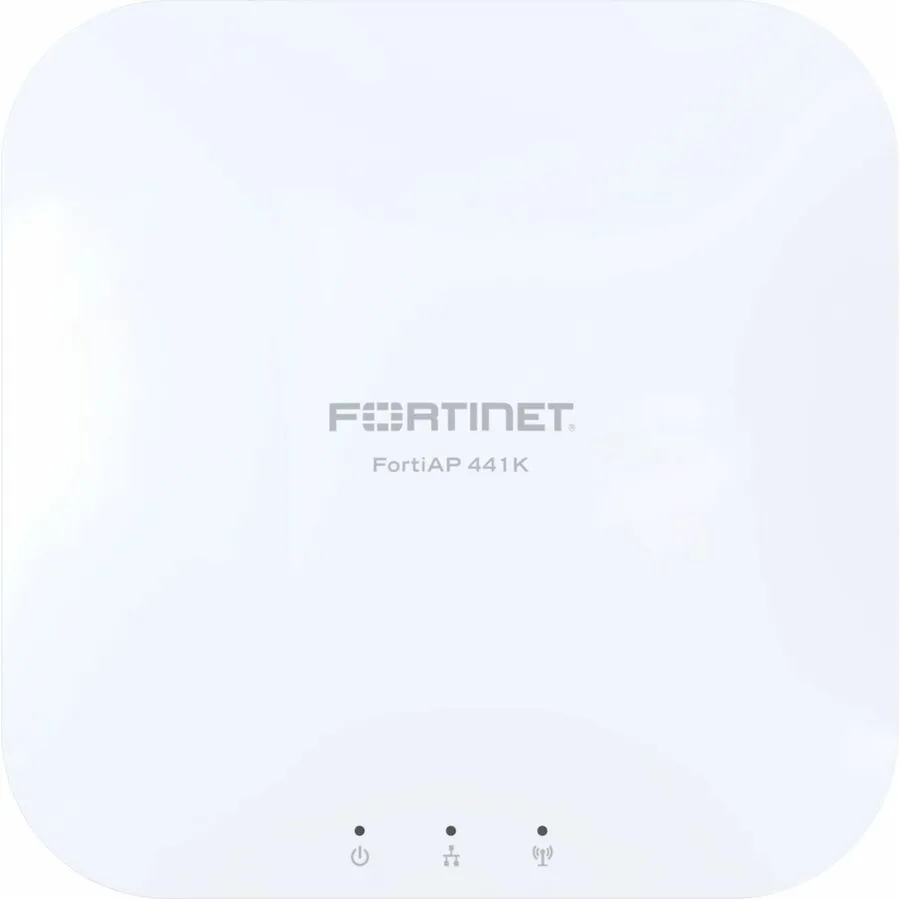

Fortinet
Tri-band Wi-Fi 7 indoor access point delivering 21.32 Gbit/s with eight internal antennas, two 10 Gigabit Ethernet PoE ports and 41.70 W power draw
The FortiAP 441K-A is an indoor wireless access point built on Wi-Fi 7 technology. It delivers a combined throughput of 21.32 Gbit/s across 2.40 GHz, 5 GHz and 6 GHz bands using four radios and eight internal antennas. Two 10 Gigabit Ethernet ports with PoE support wired backhaul and power. It suits enterprises upgrading high-density environments.
This unit fits networks that can feed two 10G Ethernet links and need tri-band 4x4 MU-MIMO capacity. It supports Bluetooth Low Energy and provides USB plus serial console ports for management. Buyers whose switches only offer 1G uplinks or who lack 6 GHz regulatory clearance will not use the full radio set.
The dual 10 Gigabit Ethernet interfaces with Power over Ethernet are the spec that determines fit. They supply both the multi-gigabit backhaul and up to 41.70 W power draw required by the four-radio array. Sites without 10G cabling or sufficient PoE budget should consider a different model.
No published specifications for this item yet.
The unit draws 41.70 W at full load, so sustained operation will add that amount of heat to the room; plan ventilation accordingly.
You need Cat 6a or better cable and a switch that can deliver PoE on 10 GbE RJ-45 ports to power and connect the access point.
Yes, the tri-band design runs 2.40 GHz, 5 GHz and 6 GHz simultaneously, so older 802.11 clients stay on 2.40 GHz while newer devices use the higher bands.
Also in this aisle
Same shelf, same checkout — eight coins and a 30-minute rate lock.
What you pay in, and what you read prices in.
Sent from your wallet at checkout
Display only — the catalogue is priced in USD
No currency matches that.
Pick the language the site speaks to you in.
No language matches that.
New here?
Already have one?
There is no automatic reset: this shop sends no mail, so there is no one-time link to ask for. Leave the address on the account and it gets picked up by hand.
Request noted
Nothing is on its way to your inbox — this shop sends no mail at all. Someone picks these up by hand.
Remembered it?


