Broadcom
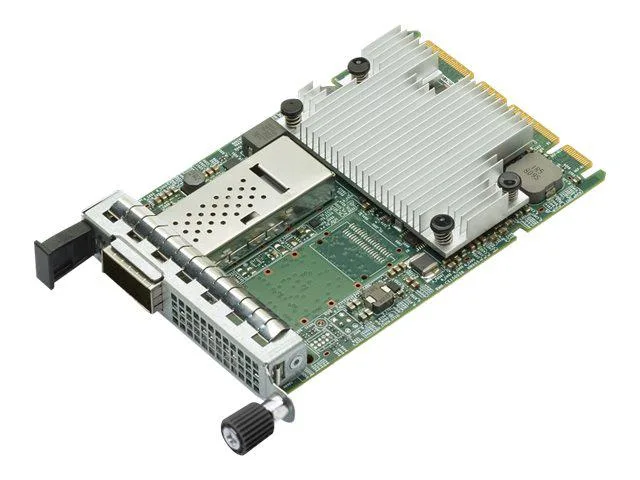
Broadcom BCM957504-N425G quad-port 25 Gb/s network card
- 25Gbps
- 4 x SFP28
$520.99
0.00624247BTC
In stockWe take cryptocurrency — so the coins you hold can buy real hardware.Pay in crypto, spend it on real hardware. Free insured shipping worldwide over $399. Plain, unbranded boxes, sent from Germany.Free insured shipping over $399. Your rate is locked for 30 minutes once checkout opens.Rate locked 30 minutes. Every item sealed, serial-checked and covered by a 24-month warranty.Sealed, 24-month warranty.

Broadcom
Dual-port 200 Gb/s QSFP112 network card with PCIe 5.0 x16 host interface and 400 Gb/s total bandwidth
Connector QSFP112
The Broadcom BCM957608-N2200GQP00 is a dual-port 200 Gb/s Ethernet network interface card built for AI, cloud and high-performance computing clusters. It uses a PCIe 5.0 x16 host interface and two QSFP112 cages to deliver 400 Gb/s total bandwidth. The OCP 3.0 form factor targets rack-scale deployments that need standards-based RoCEv2 with hardware congestion control.
The card installs into a PCI Express 5.0 x16 slot and auto-negotiates link rates of 32, 16, 8, 5 or 2.5 GT/s with lane configurations down to x1. QSFP112 modules must match the 100/50G PAM4 or 25G NRZ SerDes capability; mismatched optics will prevent link-up. Secure Boot, SPDM attestation and OCP Secure Recovery require platform firmware support to function.
Eight SerDes lanes run at 100/50G PAM4 or 25G NRZ to maintain 400 Gb/s aggregate throughput under continuous AI/ML and storage traffic. Hardware-based DCQCN congestion control and Peer Memory Direct offloads keep latency stable during prolonged bursts. IEEE-1588v2 timestamping and automated configuration assist deterministic performance in multi-node environments.
| Brand | Broadcom |
|---|---|
| Model | BCM957608-N2200GQP00 |
| Part Number | BCM957608-N2200GQP00 |
| Features | Network Interface: 8 SerDes capable of 100/50G PAM4 and 25G NRZ QSFP112 support 1x 400GbE 2x 200/100/50/25GbE 400Gb/s total bandwidth Auto-negotiation with auto-detect IEEE-1588v2 Host Interface: 16 lanes of PCI Express 5.0 Link rates: 32, 16, 8, 5, 2.5 GT/s Lane configuration: x16, x8, x4, x2, and x1 MSI-X support Platform Security: HW Secure Boot (RoT) Attestation (SPDM) OCP Secure Recovery Secure Wipe and Restore OCP Silver Security Badge (Cert Pending) RoCEv2: Standards-based DCQCN Peer Memory Direct Smart Congestion Control and Advanced Telemetry Automated Configuration |
| Shipping weight | 0.91 kg |
| Package size | 25 × 25 × 25 mm |
Other versions of this model
Same family, different memory, cooler or clock — compare before you commit.
Check the link status in the OS or switch CLI; each QSFP112 port should report 200 GbE with auto-negotiation and IEEE-1588v2 active.
The card ships alone; you must add two QSFP112 transceivers or direct-attach cables and a PCIe 5.0 x16 slot.
Choose 2×200 GbE when you need two independent 200/100/50/25 GbE links; choose 1×400 GbE for a single 400 GbE pipe.
Also in this aisle
Same shelf, same checkout — eight coins and a 30-minute rate lock.
What you pay in, and what you read prices in.
Sent from your wallet at checkout
Display only — the catalogue is priced in USD
No currency matches that.
New here?
Already have one?
There is no automatic reset: this shop sends no mail, so there is no one-time link to ask for. Leave the address on the account and it gets picked up by hand.
Request noted
Nothing is on its way to your inbox — this shop sends no mail at all. Someone picks these up by hand.
Remembered it?